Whitewash
A single-player, 2D, side-scrolling platformer set in a world without color. Collecting orbs colors the player and the environment. The game ends in a flood sequence, where the player must platform through the level before the paint erases everything.
Project Details
Release Date: Summer 2018
Development Time: 4 weeks
Platform: PC
Engine: Unity
Behind the Design
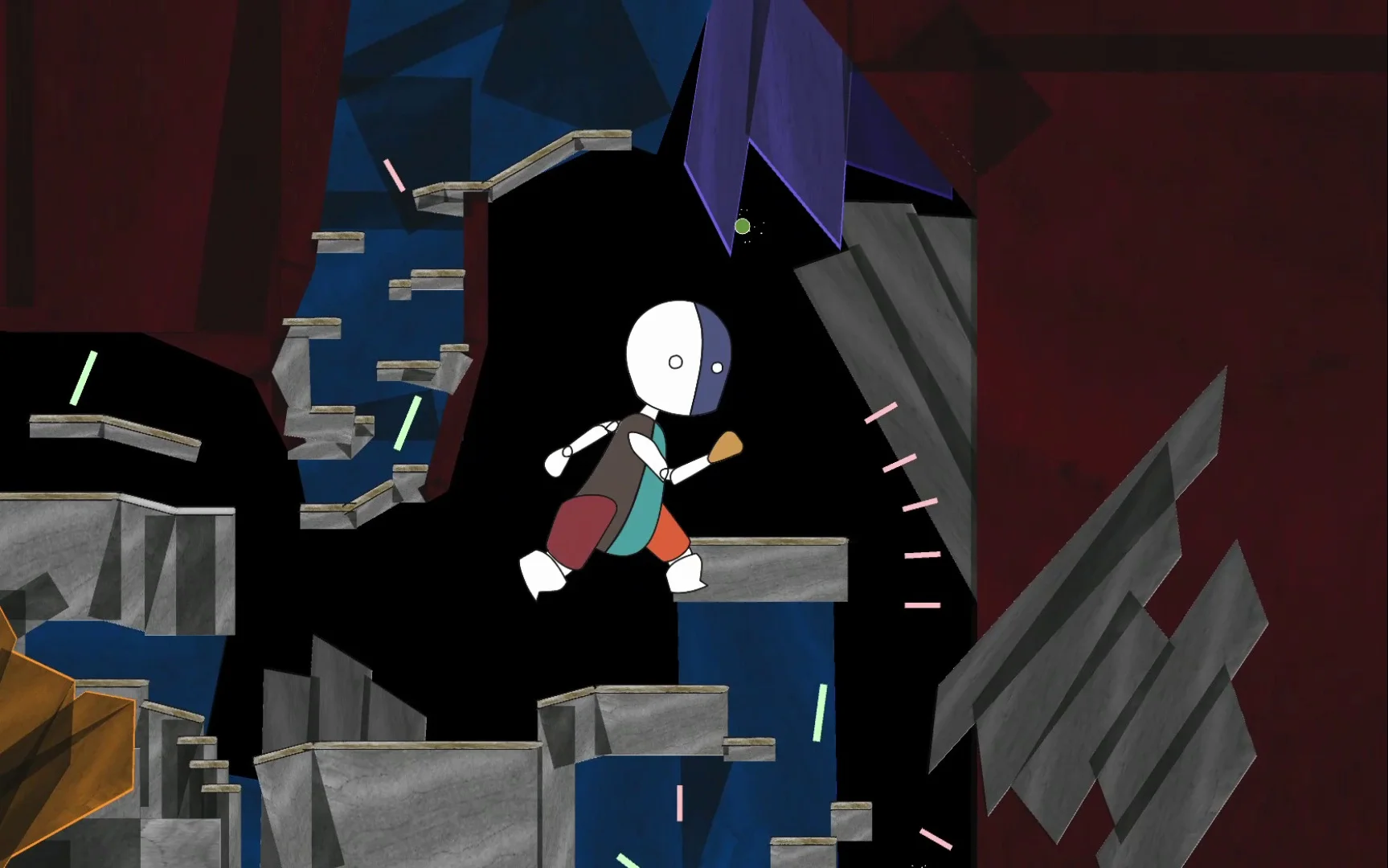
Whitewash was developed as a class project that focused on challenge and accomplishment. To create challenge, the player’s scale changes whenever they pass through a bar (green grows and red shrinks). The player must navigate the world and figure out how to collect all the colors by changing their size. To create a feeling of accomplishment, I wanted to show players how their actions affected the world around them and be able to see the result at the end. To emphasize this, I made sure that the player ended where they started. I also did not want to use a HUD. Instead, collecting colors directly reflects the player sprite and the environment.
Together, both mechanics allow the player to track their progress and set objectives. When players grow large, they are able to survey the world for more orbs to collect. Shrinking, on the other hand, allows them to platform with speed and reach tight spaces.
The overall game idea was inspired by watching my mom prime canvass for painting. She would coat old paintings with white paint and reuse them for new pieces, a process called whitewashing. The changes in size and the level layout were based on a fascination with unusually large bugs (James and the Giant Peach) and Alice in Wonderland.
Each part of the player corresponds to an element in the environment.
After learning to platform, tension is increased by flooding the world.
The player is rewarded by showing the full canvas after collecting all the colors.
The most time-consuming part of development was testing all the paths to make sure that the player does not get stuck when they change size. Finding a good location for the scaling bars, as well as determining the correct number to place in an area, took the most iteration. To capitalize on this, the scaling bars were also used to lead the player by using their angle and height from the ground.